
At first glance, what's up with that last name? It means 'Eagle's Claw', or so I am told. My great, great grandparents lived in the town of Klanderud near the Sweden/Norway border. A river passing through the town is said to split into a tributary resembling, you guessed it, an eagle's claw.
As the story goes, my great, great grandparents were forced to leave their homeland area, ironically, because they were interracially married: one was Swedish, the other Norwegian.
Coming to America, they settled near one of the thousand lakes of Minnesota.
That was my father's side, more on that later, as for my mother her story is no less interesting.
After the Civil War, the Union pushed Native American peoples west. One such aggressive move was known as the 'Trail of Tears'. My great, great Seminole/Cherokee grandmother was 12 years old at the time, rounded up by the Union soldiers and set to march off toward Oklahoma and any point west.
She was able to wander from the main group, though, and was lost somewhere in Mississippi.
Eventually, she married a young Methodist traveling evangelist and they made the circuit from Mississippi round up through Missouri, all the way to Ohio and back again. The minister was also of Native American and African American descent. They had 5 children, one of them my great grandfather, Homer Hunter.
Homer became a mason living in and constructing much of the town of Piqua, Ohio. He later had an African American partner who was an architect.
Homer married very young a wife of Cherokee and African American descent. We all called her 'Sugar Pie'. They had 2 children, a son who was lost in a drowning accident at age 12, and a daughter, Virginia.
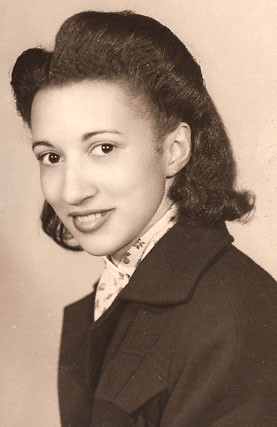
Virginia married a would be doctor, African American/German/Native American Howard Brown. Howard played football in his youth, served in WWII as an Army medic and returned to a still very segregated United States - wanting to pursue medical school, but was only able to reach the position of the local mailman in Sidney, Ohio.
Howard and Virginia had 5 children and attended the local 'black' Baptist Church.
They both had accomplished something remarkable for their time: my mother's parents were one of the very first to defy housing segregation during the civil rights movement.
Howard and Virginia moved to an all white suburb on the edge of town - the 'black' community saw this daring moved as 'uppity' and 'trying to be white'. The 'white' community saw it as a possible threat to their suburban solidarity.
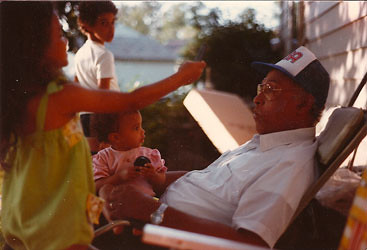
Howard was welcomed to the neighborhood by someone putting a burning paper bag full of dog feces on his front porch. Upon stomping it out, he got the message from his new neighbors. My mother says that this was the only time she ever remembers seeing him break down and cry.
Needless to say, Howard and Virginia's children grew up with a varied perspective of race and culture. My mother, Judy, their oldest daughter, from what I gather was supposed to go on to 'better the black race'. Instead, she dated and married the possibly most whitest, white man, my father, Vernon.
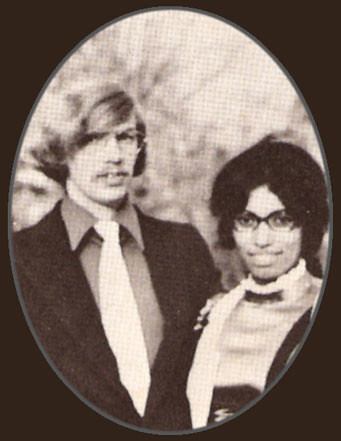
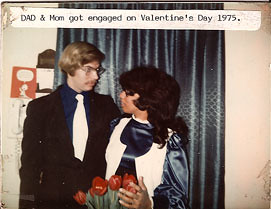
They married and bore me the next year, I was a bicentennial baby of 1976. I am the oldest of 4 with 3 younger sisters.
As far as my cousins go, I have on my mother's side of the family a mixture of (obviously) Native American and African American, also married in, German and Haitian. On my father's side, again, Scandinavian, and also married in Japanese.
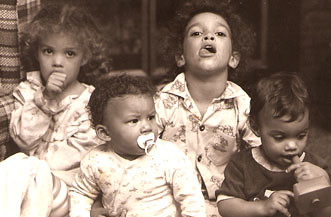
I hope this brief sketch of my multi-racial, multi-heritage background lays out some of the rationale for my part in this discussion. Questions such as 'Who am I?' and at times, 'What am I?' have come up quite frequently throughout my life.
As being the primary contributor to this blog, my desire is to go beyond just asking the questions 'What racial mix are you?', or 'What problems do you face from others by being of mixed-race?' There is so much more to the discussion.
I will endeavor to explore the more positive aspects of being a multi-racial person in a world that is increasingly changing it's borders, and socially getting smaller, more crowded. I will go into the darker issues as well - anyone of mixed-race heritage knows that these issues are extreme for many of us.
I will also lay out what I see as the oncoming as well as persistent challenges that we all face now and in the nearer future.
Questions like:
'Are multi-racial people to be considered a racial group all their own?',
'Are multi-racial people able to find unity through our unique characteristics and experiences?', and 'What is the future of Mixed-Race people, if not only for America, but obviously, our relatives connected throughout the world?'
Look forward to weekly posts for discussion.
Jason Klanderud

